Nine questions to ask a vendor that checks AI images for other people's IP
For studio lawyers choosing a check for AI images: what to ask the vendor before the first test, and how to tell a real answer from a dodge.
Before a studio lets an AI image check into its clearance process, its lawyer can ask the vendor nine questions: what the check compares against, what the score means, how it explains a match, how often it is wrong, what record it leaves, and who pays when it misses.
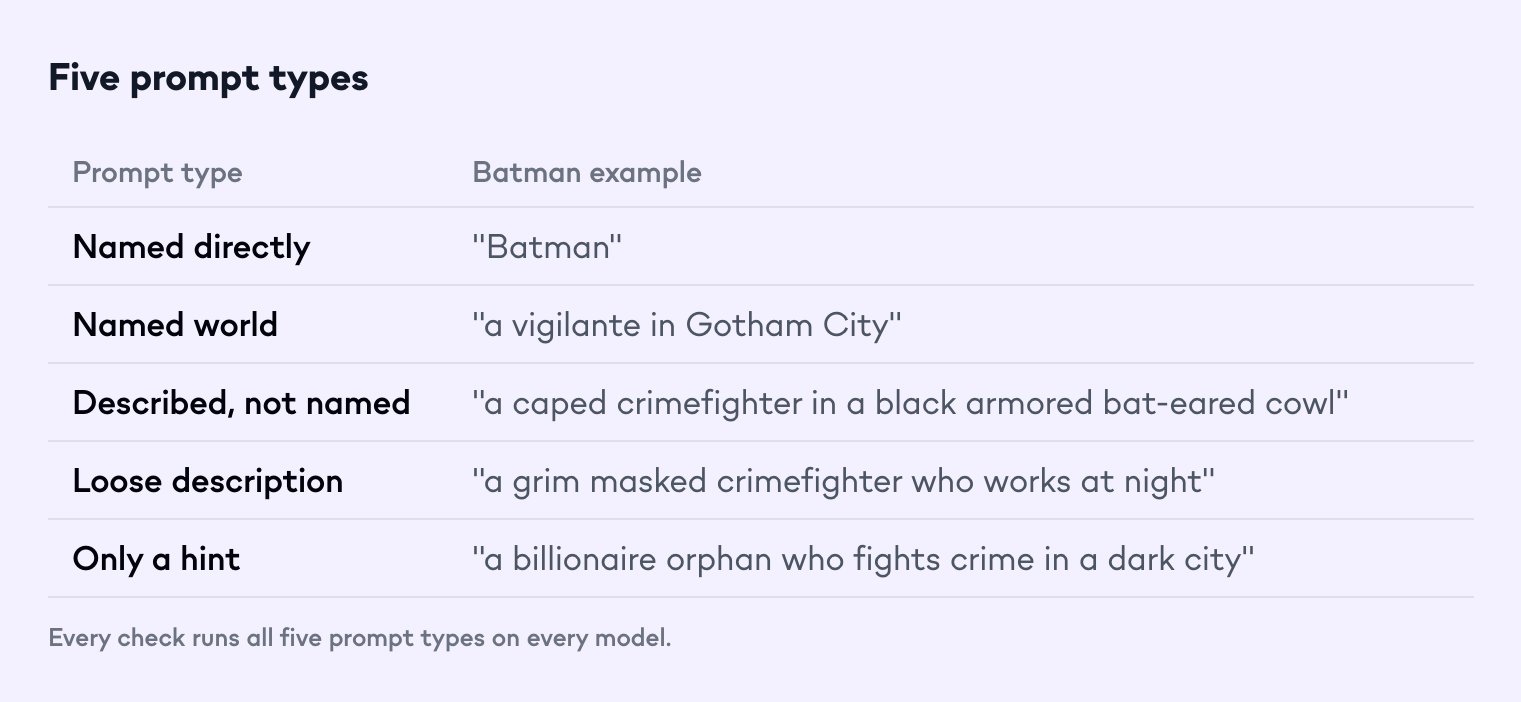
An AI model draws an image in seconds. That image can carry someone else's work: a character, a logo, an actor's face, a recognizable piece of art. Models learn from images like these and can reproduce them even when nobody named them in the prompt. We showed how that happens in A clean prompt is not a clean image.
If that image ships in an ad or a film, the studio answers to the rights holder. Being made by AI is no defense. We covered that in AI law myths: owning AI output does not protect you from a lawsuit.
So studios have started checking AI material before release. Separate services do this, and CopySight is one of them. You upload a file. The service compares it with a library of known characters, brands, faces and works. Then it shows what the file resembles and how closely.
If you are a studio lawyer picking one of these services, there is little to go on. Law firms publish guides on what to check before using an AI service commercially, Sprintlaw for one. Those guides are about the generator: who owns the image, what the model was trained on. They don't cover the service that looks for someone else's work inside the image. We listed the first three questions for it in Copyright works after the fact. AI doesn't wait: show me the score, tell me what happens on a match, give me a record. This article goes further.
Here are nine. Studios, platforms and agencies asked us almost all of them in the last two weeks. For each one: why it matters, and our own answer where we have one.
1. What it compares against
A check finds only what is in its library.
2. Reverse search or not
An AI image is usually not a copy of one file online.
3. What the score means
A lawyer decides infringement, not a number.
4. What it explains
A lawyer needs the match and the spot in the frame.
5. How often it is wrong
False alarms cost time. Misses ship with the release.
6. Same file, same score
A score that moves is hard to rely on in a dispute.
7. What record it leaves
A screenshot with a checkmark won't do.
8. What happens to your files
Unreleased material goes into the check.
9. Where it sits, who pays
The check runs before release, and a person decides.
1. What does the service compare against, and what does it skip?
A check finds only what is in its library. If a character isn't there, the check won't see it, and the studio will think the file is clean.
An IP lawyer at a stock image platform asked us how well our library covers Japanese manga and anime. Others ask about music. A good answer lists what the library covers and what it leaves out. It also says how often the library is updated.
The same lawyer asked about style. The argument: a drawing style, like Studio Ghibli's, isn't protected by copyright. If a check flags style as risk, clients get scared for nothing. Ask whether the service tells a style apart from a specific character.
Our answer: CopySight checks images, video and 3D models. It doesn't check music or text. On music, I said on The Magnifier podcast (October 28, 2026, in the chapter that starts at 08:14): "It's just a mess. You don't want to go there."
2. How is this different from a reverse image search?

Studio lawyers asked this when they saw screenshots of a check result. Google's reverse image search is free, and a lawyer wants to know what the money buys.
Reverse image search finds copies of a file that already exists online. An AI image is usually not a copy of one file online. It assembles recognizable pieces from different sources: one superhero's head, another's suit, a third one's cape. That file exists nowhere online, so a reverse search finds nothing. Ask the vendor to show a match on an image that has no original.
Reverse image search
Finds copies of a file that already exists online.
Similarity check
Finds recognizable pieces of other people's work inside a new image.
3. What does the score mean, and what doesn't it mean?
The service returns a score: a number that shows how closely the file resembles someone else's work. Studio lawyers told us that a "safe / unsafe" label looks like a legal ruling. It isn't one. They added that infringement depends on how and where the material is used. A lawyer decides that, not a number.
A good vendor says so first and puts it in writing. Also ask who decides at what score a file goes to a lawyer. Some clients want the service to raise more flags, others fewer. That is the studio's call. A good result shows which threshold the check used.
Our answer: the score measures similarity, not infringement. A low score doesn't guarantee the material is safe to release. A high score doesn't mean rights were infringed. Our Terms of Use say it directly: the score isn't legal advice and doesn't replace review by a lawyer. For faces and celebrities, the user sets how confident a match must be before it shows, 50% by default. The app notes that a higher setting means fewer false alarms and more misses.
4. Does the service explain what it found?

A single number tells a lawyer nothing. The lawyer needs to know what the file resembles and where in the frame. That is what decides the next step: replace the shot, get a license, or release as is.
A good answer marks the spot in the frame and names the match.
Our answer, with the example I gave on the same podcast (in the chapter that starts at 20:48). Upload a photo of the actor Jon Hamm, and the service says it's Jon Hamm. Upload an AI image of him in character, and it says it's Jon Hamm and also Don Draper from Mad Men. For a lawyer, those are two separate questions: the actor's rights in his likeness, and the rights holder's rights in the character.
5. How often is the service wrong?
A check can be wrong in two ways. It raises a false alarm, and a lawyer spends time on a clean file. Or it misses a real match, and the risk ships with the release.
The stock platform lawyer asked us for our error rate. A good answer gives both kinds of error and names the set of files they were measured on. A rate without that set means nothing: any service looks accurate on easy images. Also ask whether you can mark an alarm as false, and whether that mark is saved.
Two ways a check is wrong
- False alarm. A lawyer spends time on a clean file.
- Missed match. The risk ships with the release.
6. Does the same file get the same score twice?
Before a meeting with us, a cloud provider asked whether a score holds if you check the same file again. A score that moves from run to run is hard to rely on in a dispute.
A good answer states the spread the vendor considers normal. Test it yourself: upload one file three times.
7. What record does the check leave?

If a claim arrives a year later, the studio will want to show it checked the material before release. Studio lawyers told us a screenshot with a checkmark won't do. They want a report.
This is what a lawyer looks for in the report:
| In the report | Why the lawyer needs it |
|---|---|
| Date of the check | Shows the check came before release |
| File fingerprint, a code that changes with any edit | Proves the checked file is the one that shipped |
| Version of the service | Explains why the score is different a month later |
| What was found, and where in the frame | Shows what the check saw |
| Who reviewed the result, and what they decided | Shows a person made the call |
Our answer: for each finding, CopySight shows what the file resembles and how closely. It shows the type of match: trademark, brand or iconic design, character, celebrity or famous person, or art and artist. It shows the author, the owner, and the box in the frame where the match sits. Ask any vendor, including us, about the other rows.
8. What does the service do with your files?

A studio uploads material that hasn't been released. A leak before the premiere, or someone training a model on that file, is a second risk, this time to your own material.
Ask whether the file is stored after the check and for how long, who can access it, and whether anyone trains models on it. Then compare the answer with the contract and the privacy policy. Rely on what is written.
9. Where does the check sit in the process, and who pays if it misses?
A check works only if it is built into the process before release. Studio lawyers asked how to fit it into the way the studio already approves material, and whether the service replaces the lawyer. It doesn't. A good order: the check runs before release, a person reviews the result, the decision gets written down.
The Warsaw Glitch film festival, for one, checked every nominated film before its awards.
The last question is money. An IT lead at an ad agency told us the agency works only with AI services that promise to cover losses. But in practice that coverage is limited, and it pays after the problem. So the agency would rather prevent the problem. Ask the vendor what its contract says if the service misses a match.
What to do before the first test
Put together 20 to 30 of your own files:
- a few that certainly contain a known character, your own for example;
- a few that are clean;
- a few where a character is built from pieces of different heroes.
Check each file three times. See what the service found, what it missed, and whether the scores matched. Read the report the way the other side's lawyer would read it in a dispute. And decide in advance who reviews the result and at what score a file goes to a lawyer.
You can run that set through CopySight: copysight.ai/signup.
Artem Petrov is co-founder and CEO of CopySight.
This is not legal advice.
Illustrations generated with AI (Nano Banana Pro via fal.ai) in the CopySight illustration style and scored with CopyScore: no protected IP detected, risk low.
Score a generation before it ships
CopySight checks an AI-generated image against known characters, faces and brands, and returns a similarity score with the matches behind it.
One long-form a week
We publish one article a week on how AI copyright risk actually works and what teams do about it. Leave an email and each one arrives the day it goes up.