Copyright works after the fact. AI doesn't wait
Notes from the Human-Led, AI-Enabled panel at First Entertainment Credit Union, September 18, 2026. Eighteen questions from the room, folded into one argument.
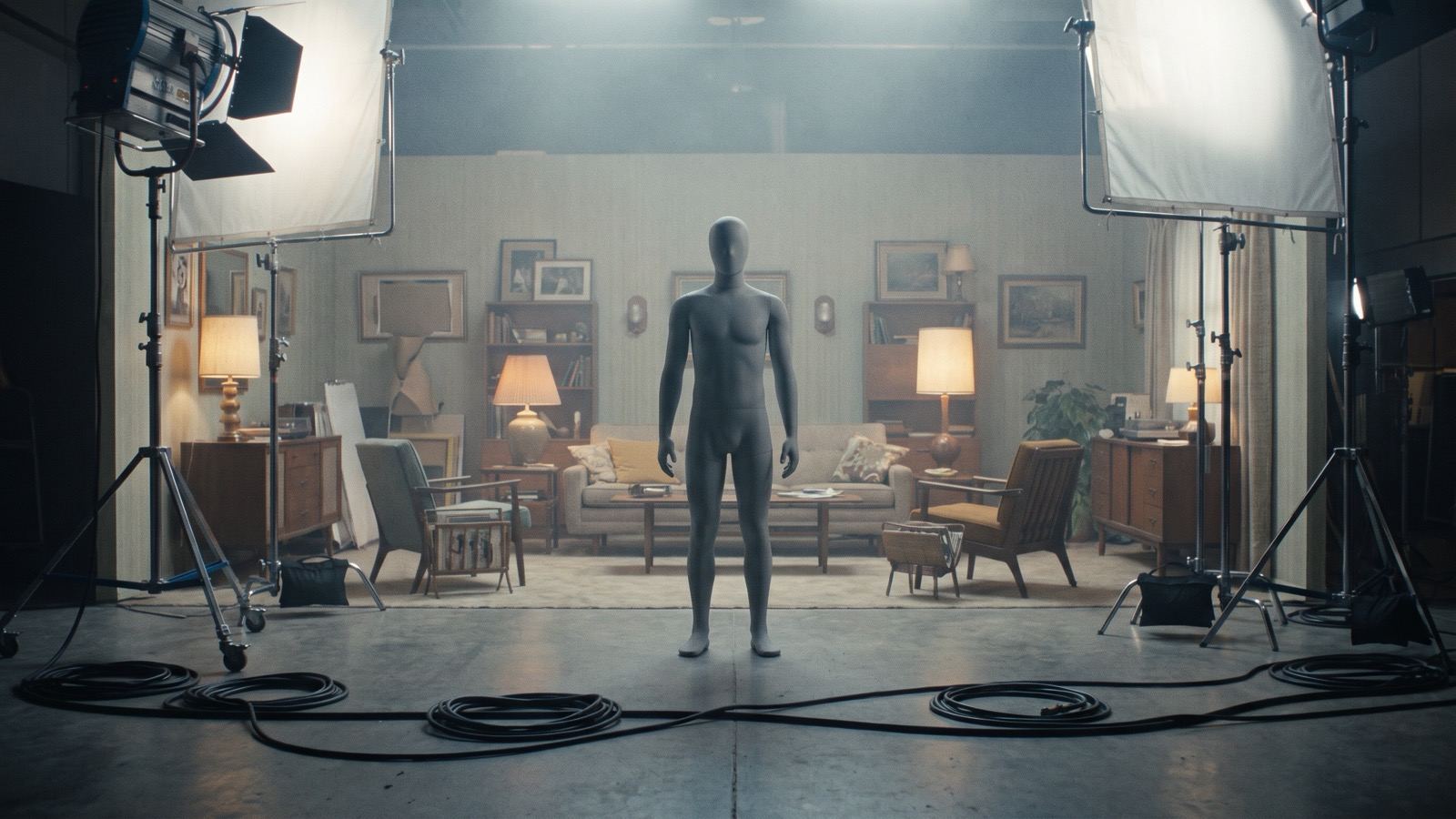
A stock mannequin on a dressed set, the kind of asset nobody thinks to clear. Image generated with AI (Nano Banana Pro via fal.ai) and scored with CopyScore: no protected IP detected, risk low.
Copyright law was built to catch infringement after it happens. Generative AI creates it before anyone is looking, at prompt speed and at a scale no lawyer can review by hand. The fix isn't better contract language. It's provenance built into the production pipeline: a record of where every element came from, and a risk score before the asset ships. That's what CopySight builds, and that's what we argued on the panel.
The panel was "Human-Led, AI-Enabled: The Future of Hollywood Production", hosted by First Entertainment Credit Union on September 18, 2026 and moderated by filmmaker Alton Glass of GRX Immersive Labs. On the program with us: Monica Monique, Joy L. Ganes, Esq., and Geoffrey Kater. Eighteen questions came in ahead of time. Here they are, folded into one argument.
Three things it comes down to:
- Copyright wasn't built for content that ships faster than it can be reviewed.
- Provenance isn't paperwork. It's infrastructure. Build it in at creation, or do forensics after the lawsuit.
- The prompt isn't the IP. The output is. Stop arguing about the pitch, start scoring the movie.
The first question in the room was about fear, the "it's coming for us" headlines. Fair enough. But AI didn't create the IP infringement problem. It made the problem undetectable at human speed. We didn't start this company because we're scared of AI. We started it because we bet the fix for AI is better AI, not less of it.
Is the prompt the IP, or is the output?
The output. A recipe isn't the meal.
The prompt is instructions. The output is the thing that can infringe, get licensed or get sued. That's where the risk lives, that's where the value lives, and that's the part you can measure today. The Copyright Office says prompts alone don't make you an author. A British court said Stable Diffusion's weights aren't a copy of anything, then found the watermarked images it generated did infringe. The model was cleared. The output wasn't.
So the line between "AI as a tool" and "AI instead of vision" isn't where people draw it. The tool isn't the problem. Not knowing what it copied is. Full provenance on every asset is a tool. No idea what the model pulled from is gambling with someone else's IP and calling it vision. We measured how often that happens: prompts that named nothing still returned owned material.
Can AI output infringe something nobody asked for?
Yes. That's the part most teams miss.
It used to be one rights conversation per asset. Now it's one per pixel cluster. A model doesn't know "the whole image belongs to me." It only knows what it was trained on. Risk can sit in one corner of a frame while the rest is completely original.
Film has been here before, just slower. In 1997 a poster of a Faith Ringgold quilt hung on the set of an HBO sitcom. Nine shots, 26.75 seconds in total, some out of focus. The appeals court said that's not too small to count: if a regular viewer recognizes the work, it's copying. One background prop. A generative model puts a prop like that in every frame.
Here's what it looks like today. During rehearsal one panelist ran our tool on assets from his own virtual-production pipeline. It flagged Unreal Engine mannequins he'd used for years without a second thought. Everyone thinks IP risk means "did the AI copy Mickey Mouse." The real exposure is a game-engine mannequin, a stock rig, a font, a background asset nobody licensed for commercial output. Epic's content license has terms. Nobody in that pipeline had read them, because nobody thought of a mannequin as a risk.
Provenance isn't about catching the Mickey Mouse ears. It's about catching what you didn't think to ask about.
Who owns AI-assisted work?
A human does. And the proof is a paper trail, not a philosophy.
You can't credit, protect or pay someone for a decision you can't prove they made. The law has settled the first half: the D.C. Circuit said an AI can't be an author, and in March the Supreme Court let that stand. Humans can still own AI-assisted work. The question is what proves the human part. We quote what the U.S. Copyright Office wrote about owning AI output in a separate post.
Invoke showed the answer. The Copyright Office refused its image "A Single Piece of American Cheese," then registered it in January 2025 once the company handed over a video of the process: about 35 inpainting edits, choosing and arranging the pieces. The record of decisions proved authorship, not the picture. We did the same for a client last year.
Pay follows measurement. You can't build residuals or licensing for AI-assisted work until you can say how much of it is new and how close it sits to something protected. That's a scoring problem before it's a legal one.
Six decisions a production team can plan against, last checked September 21, 2026:
| Ruling or rule | Date | What it decided | On set |
|---|---|---|---|
| Thaler v. Perlmutter, D.C. Circuit; certiorari denied | March 18, 2025; March 2, 2026 | An AI system can't be the author. A human can hold copyright in AI-assisted work | Record the human decisions |
| "A Single Piece of American Cheese", U.S. Copyright Office | January 30, 2025 | Registered on selection, coordination and arrangement of AI material, after a process video of about 35 inpainting edits | Keep the process record |
| Ringgold v. Black Entertainment Television, 2d Cir. | 1997 | 26.75 seconds of a poster in a sitcom background was not de minimis | Background props count |
| Getty Images v. Stability AI, High Court of England and Wales | November 4, 2025 | Model weights are not an infringing copy; watermarked outputs infringed trademarks | Check the output, not the model |
| Bartz v. Anthropic, N.D. Cal., final approval | July 20, 2026 | $1.5 billion, about $3,000 per work, for pirated training inputs; output claims not released | Inputs are priced, outputs stay open |
| EU AI Act Article 50; California SB 942 | from August 2, 2026 | Machine-readable marking, deepfake disclosure, a free detection tool | Disclosure is a receipt, not clearance |
What kills deals: the lawsuit, or the missing proof?
The missing proof.
Everyone worries about getting sued. What actually kills deals is not being able to prove the content is clean when a studio, an insurer or a platform asks. By then it's too late to go back and check. The exposure isn't the lawsuit. It's the six months of due diligence that stall on a provenance question nobody can answer.
The lawsuits are real, to be clear. Disney and Universal are suing Midjourney, joined by Warner Bros., and asking for up to $150,000 per infringed work. Anthropic's $1.5 billion settlement, approved in July, covers 482,460 books used as training data and explicitly leaves output claims open. The biggest copyright check in U.S. history paid for the inputs. Production lives on the outputs.
But the question comes from the insurer first. Front Row Insurance, a film and TV insurance broker, now asks productions how they verify that AI-made material doesn't infringe and whether they hold rights to everything fed into the AI. Since January the standard U.S. liability policy forms carry a generative AI exclusion an insurer can switch on. "Where did this come from" is the underwriter's question now. No answer, no policy. No policy, no distribution.
Which is why the first conversation with legal before adopting AI tools comes down to one question for the vendor: can you show me where this came from? If they can't, you don't have a legal problem yet. You have a diligence problem, and it turns legal the day you publish.
And no, you don't balance innovation and risk by slowing down. Studios kill their own speed by putting the review gate at the end, where legal becomes the bottleneck. Move the check to the front of the pipeline and speed and safety stop being opposites.
What should you ask an AI vendor before commercial use?
Don't ask if it's safe. Ask them to show you the score.
Every vendor says their output is clean. That's marketing. Ask for a similarity score against protected work. Ask what happens when something's flagged. Ask for a clearance record you can hand to a studio when a claim shows up. If they can't answer, you're the one holding the liability.
For the record: CopyScore scores a generated image or video against known characters, faces, brands and styles and returns a similarity score with the matches and a record behind it. It doesn't inspect training data, and a score isn't a legal opinion. Whether a match is actionable is a question for counsel.
Do content credentials prove the content is clean?
No. They answer a different question.
Content Credentials, the C2PA standard backed by Adobe, Google, Microsoft, OpenAI and Sony, record who made a file, with what tool, and what was edited. They don't say whether what's inside belongs to someone else. Two different checks. Most vendors only run the first.
The first one is now the law. Since August 2 the EU's AI Act requires AI-generated media to carry a machine-readable mark and deepfakes to be disclosed, and California requires generative systems with over a million users to embed a mark and offer a free detector. From 2027 the big platforms have to show it. That's a receipt, not a clearance.
A receipt is the right way to think about disclosure, too. It isn't a confession. Audiences don't punish AI use. They punish being lied to about it. Nearly 90 percent of consumers told Getty Images they want to know when an image was made with AI. The winning move isn't hiding AI in the pipeline. It's showing exactly what was AI-assisted, what was scored clean, and what a human made.
What's the next licensing market?
Clean IP.
The next licensing market isn't selling footage. It's selling IP that's pre-cleared, scored and provably yours, so the buyer doesn't have to take your word for it. Right now buying AI content commercially means trusting the seller. That doesn't scale. Insurers, studios and platforms need a verifiable score, not a handshake. Whoever owns the standard for provably clean IP owns the toll booth on the AI content economy. That's the marketplace layer we're building next.
What does AI literacy mean for an executive?
One question, asked every time.
You don't need to know how a diffusion model works. You need to know what to ask before you publish: where did this come from, and can I prove it. Executive AI fluency isn't technical fluency. It's risk fluency.
Four quick ones closed the panel.
Five years out, what do you hope AI has done for the creative industries, and hope it hasn't? Hope "clean IP" is as normal and boring as a nutrition label. Hope "nobody checked" isn't the industry default.
Any AI practice that makes you uncomfortable right now? Publish first, ask forgiveness later. Everyone is optimizing for speed to output. Nobody has built the habit of checking before they hit send.
Is Hollywood too slow on AI education or too fast on adoption? Both, in different departments. Production is sprinting. Legal and education are still tying their shoes. The lawsuits come from that gap.
One thing everyone should do this week? Pick one piece of content you shipped this month. Ask yourself: could I prove where every part of it came from? If the answer is no, that's your homework.
Score a generation before it ships
CopySight checks an AI-generated image against known characters, faces and brands, and returns a similarity score with the matches behind it.
One long-form a week
We publish one article a week on how AI copyright risk actually works and what teams do about it. Leave an email and each one arrives the day it goes up.