AI law myths: owning AI output does not protect you from a lawsuit
The U.S. Copyright Office says purely AI-generated material is not protected and prompts alone are not enough. Its registration guidance does not address infringement. Courts decide that, and insurers ask first.
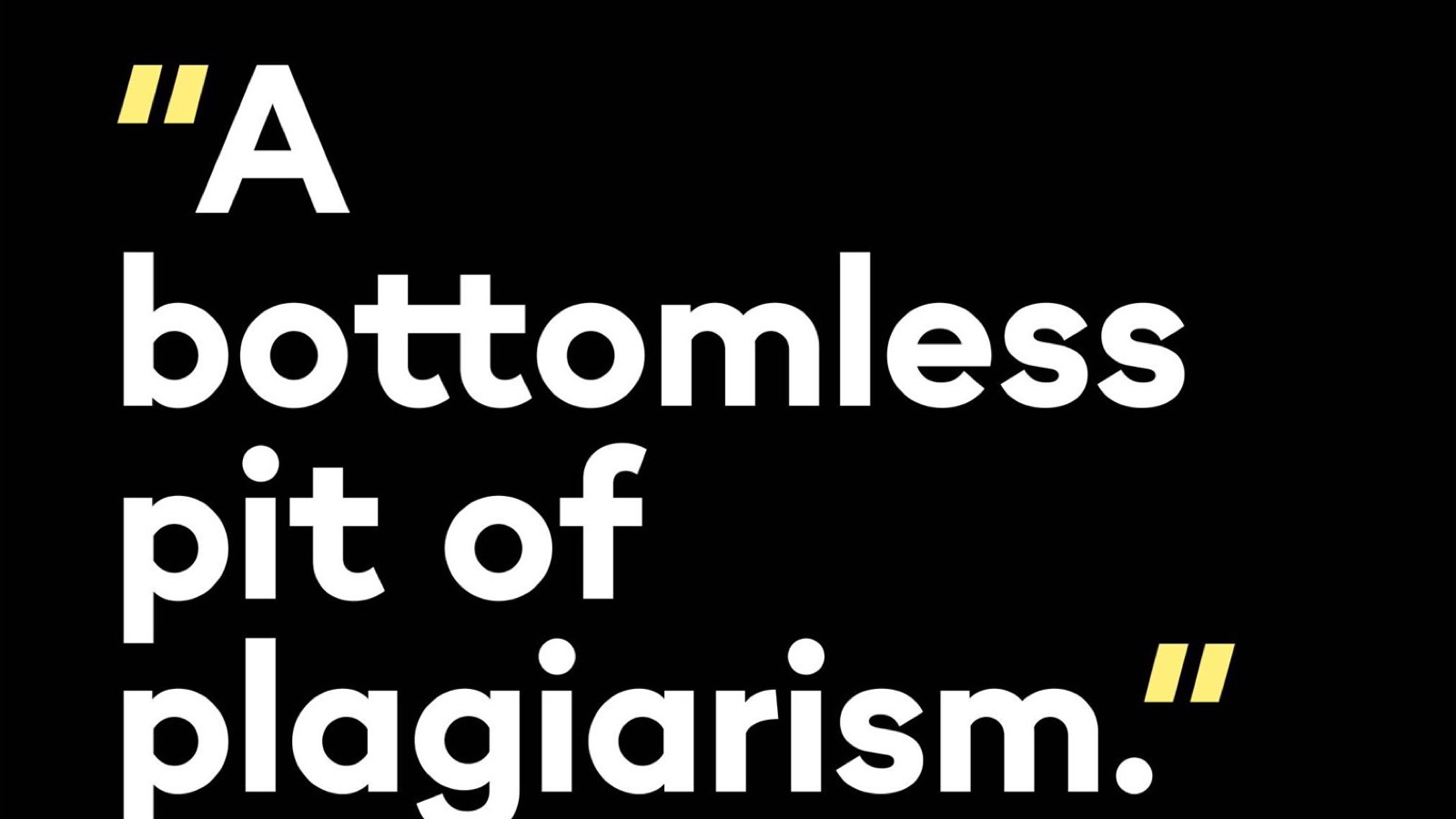
"A bottomless pit of plagiarism" is how the Disney and Universal complaint, filed in June 2025, describes Midjourney. The card is from our New York Tech Week post, June 2026.
Studios already ship material made with generative models: storyboards, backgrounds, promos, social cuts. When someone asks whether that material infringes anyone's rights, the answer rests on one of four beliefs: "it is clearly AI," "we generated it, so it is ours," "there is no law yet," "the contract covers it." Studio counsel owns that answer, and so does the agency producer when the agency has given the client an indemnity.
All four beliefs mix up two questions. Owning your material and not infringing someone else's rights are separate questions with separate answers. A document that settles the first says nothing about the second.
The U.S. Copyright Office's documents on protecting this kind of work answer only the first question: whether AI-generated material is protected and whose contribution it contains. Courts decide the infringement question. The insurance market asks it before any court does: a film and TV insurance broker already warns productions that their insurer will ask how they check material before release. A production without that step has no answer to give.
The "it is clearly AI" myth: being generated does not protect you from a lawsuit
The logic of this myth: the image is obviously synthetic, so nobody will treat it as a copy. The law looks at it differently. In an infringement dispute, the court compares the output with the other party's work, among other things. That a file was generated is not a defense.
Disney and Universal sued Midjourney, the image generation service, on June 11, 2025. The plaintiffs include Disney Enterprises and Universal City Studios Productions LLLP. The complaint's main exhibits are images that Midjourney itself produced, in other words, material that is openly AI-generated. The case is undecided, and these are the plaintiffs' allegations.
The Disney and Universal complaint (June 2025) calls Midjourney "a bottomless pit of plagiarism."
The Office has written about infringement too, but not in its registration documents. Part 3 of the Office's report "Copyright and Artificial Intelligence" came out on May 9, 2025, as a pre-publication version; the final version has not been released. In it, the Office briefly addresses the case where a model produces a near-exact replica of a protected work or closely resembles it. The Office said a fuller treatment of these infringements, including who is liable for them, will come in a later part of the report.
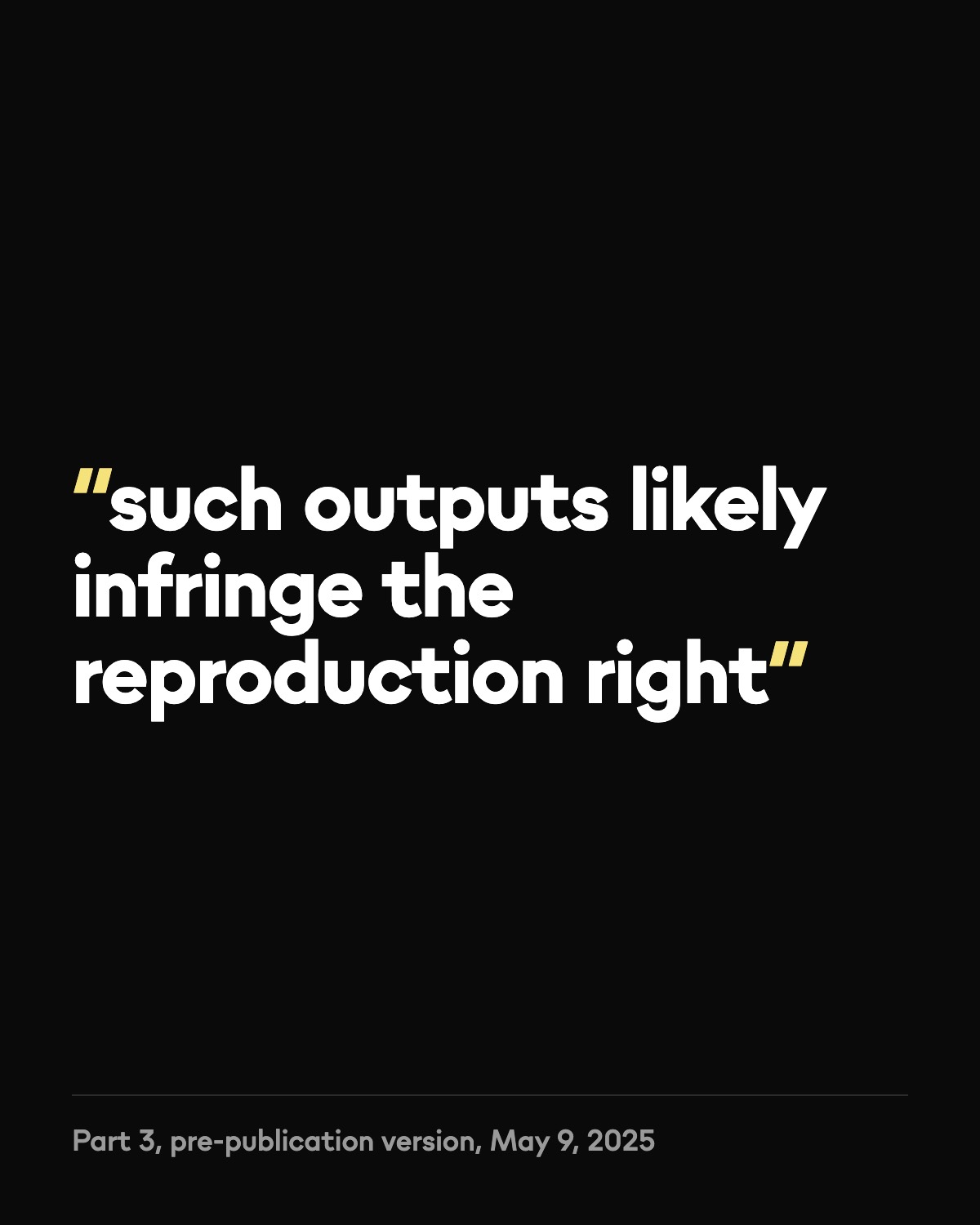
The Office's conclusion in Part 3 of the report (May 2025): "Such outputs likely infringe the reproduction right and, to the extent they adapt the originals, the right to prepare derivative works." Courts are not bound by it.
The risk is not limited to copyright. On November 4, 2025, the High Court of England and Wales ruled in Getty Images v. Stability AI. The court upheld the claim in part. Under UK law, Stability AI, the model developer, infringed the iStock trademarks through images generated by Stable Diffusion v1.x and the Getty Images trademarks through images generated by v2.x, because those images carried the watermarks. The finding rests on specific generated images.
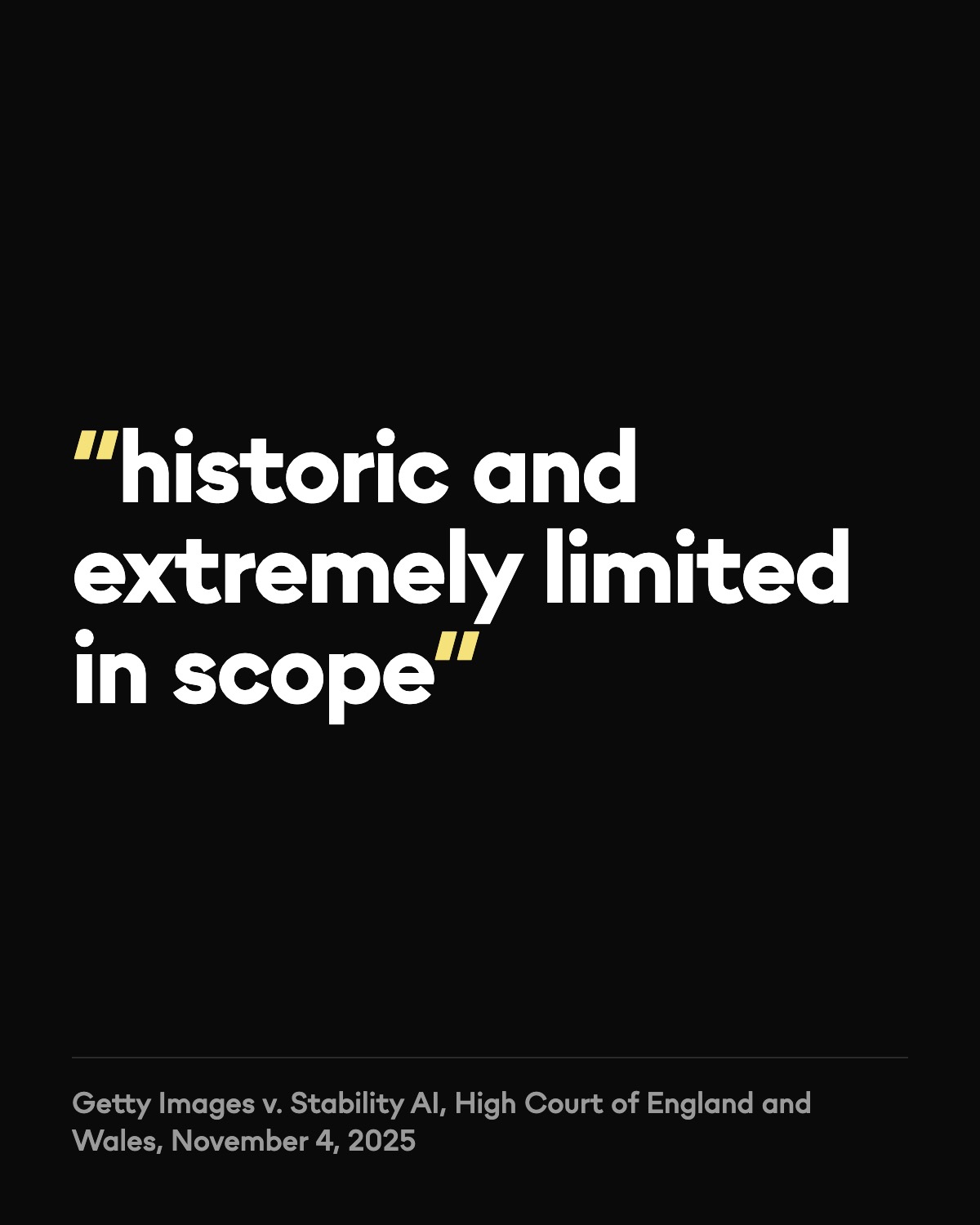
The court stressed that its findings are historic and extremely limited in scope. Shortly before closing submissions, Getty dropped part of its claims, including its primary copyright claims, and the court dismissed the remaining secondary copyright claim.
Being visibly AI-generated does not make material yours, and it does not make it safe. Those are two different problems, and one file can cause both.
The "we generated it, so it is ours" myth: only the human contribution is protected
Under U.S. law, AI-generated material is not protected by copyright on its own. The human contribution to it is. On this point the U.S. Copyright Office is direct.
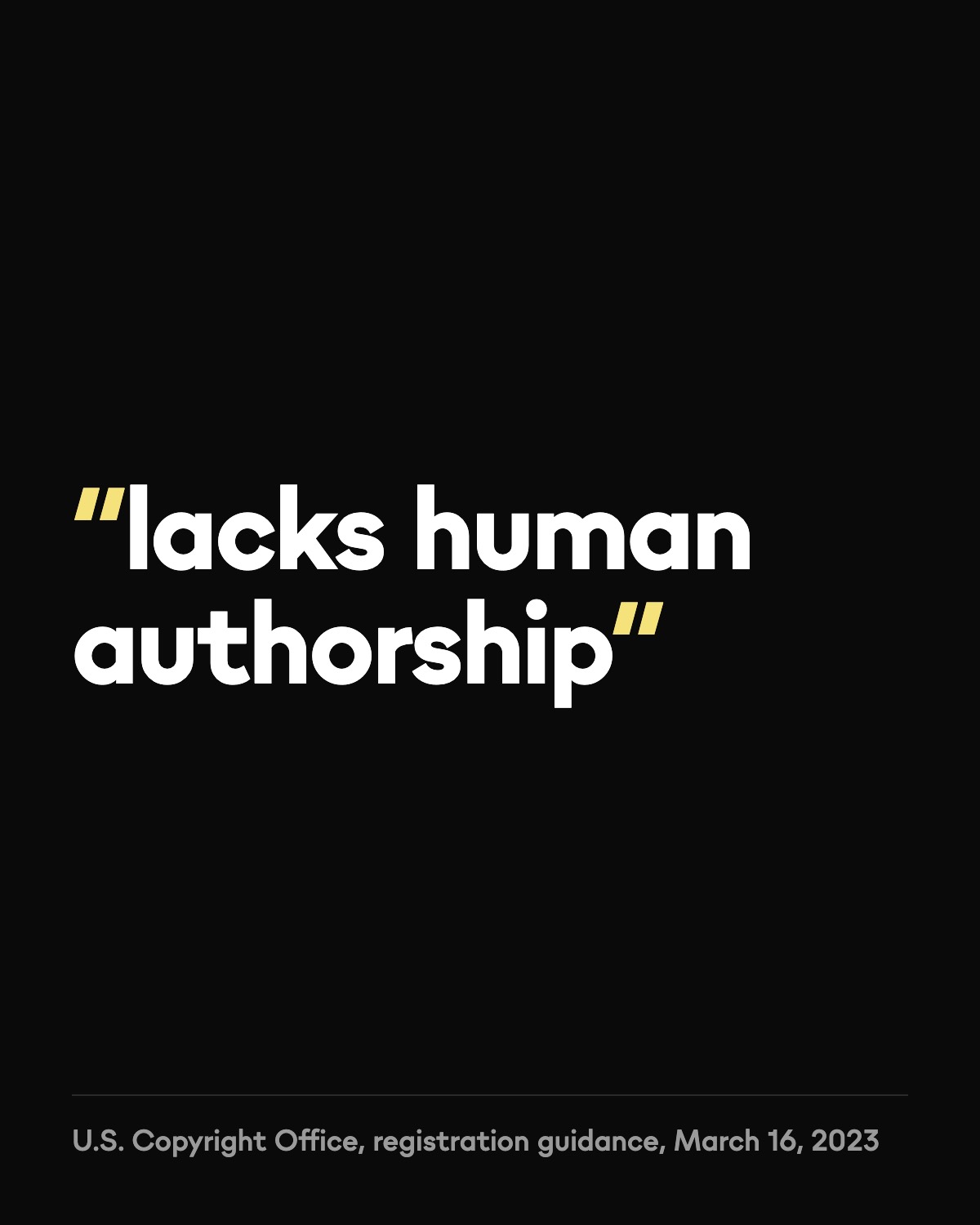
The registration guidance for works containing AI-generated material took effect on March 16, 2023, and was published in the Federal Register (88 Fed. Reg. 16,190). It states: "If a work's traditional elements of authorship were produced by a machine, the work lacks human authorship and the Office will not register it."
Under the same 2023 guidance, when a person gives a model only a prompt, the traditional elements of authorship are "determined and executed by the technology" rather than by the human user.
Part 2 of the report was prepared by the Register of Copyrights, who heads the Office. It was published on January 29, 2025.
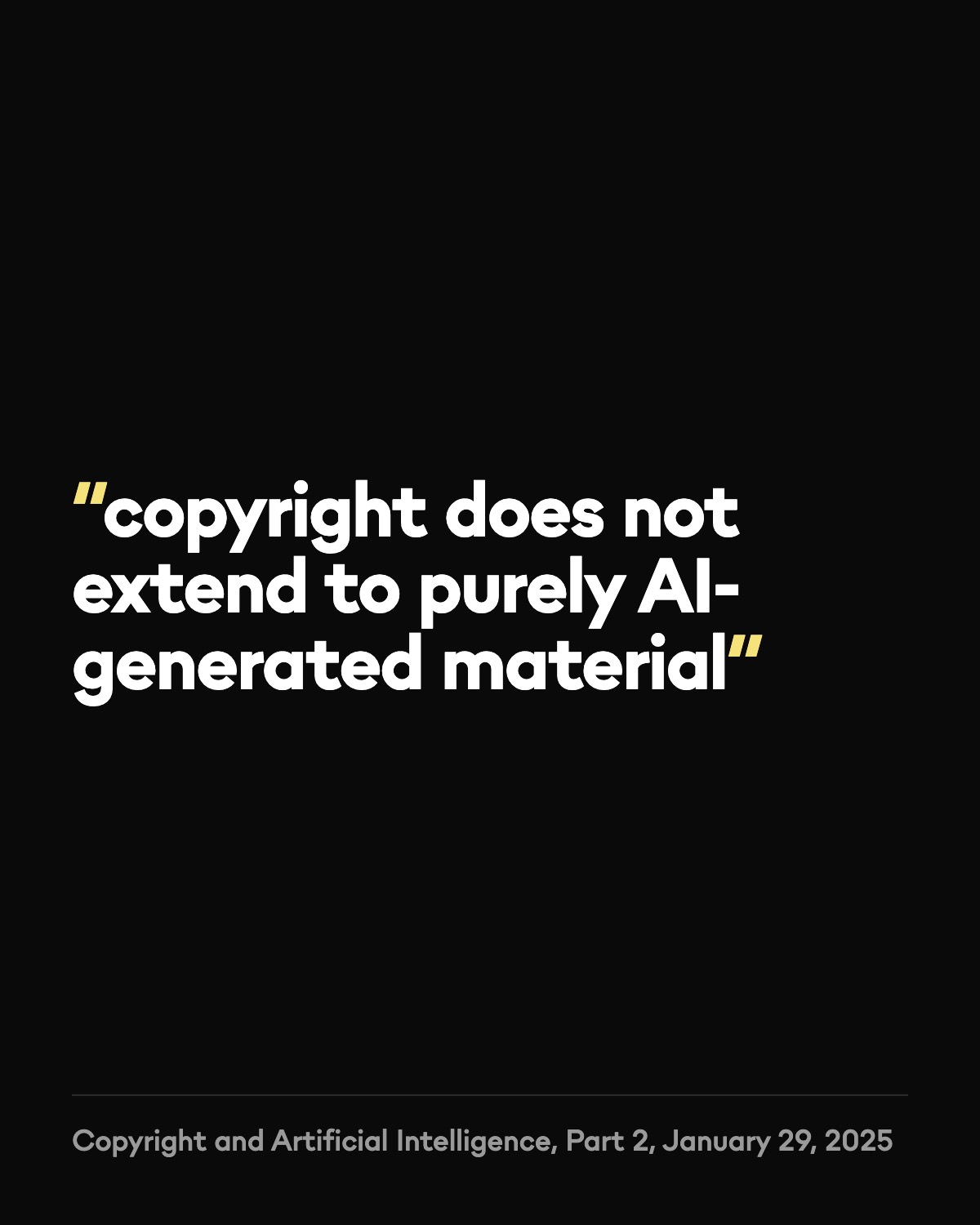
The conclusion of Part 2 of the Office's report (January 2025): "Copyright does not extend to purely AI-generated material, or material where there is insufficient human control over the expressive elements."
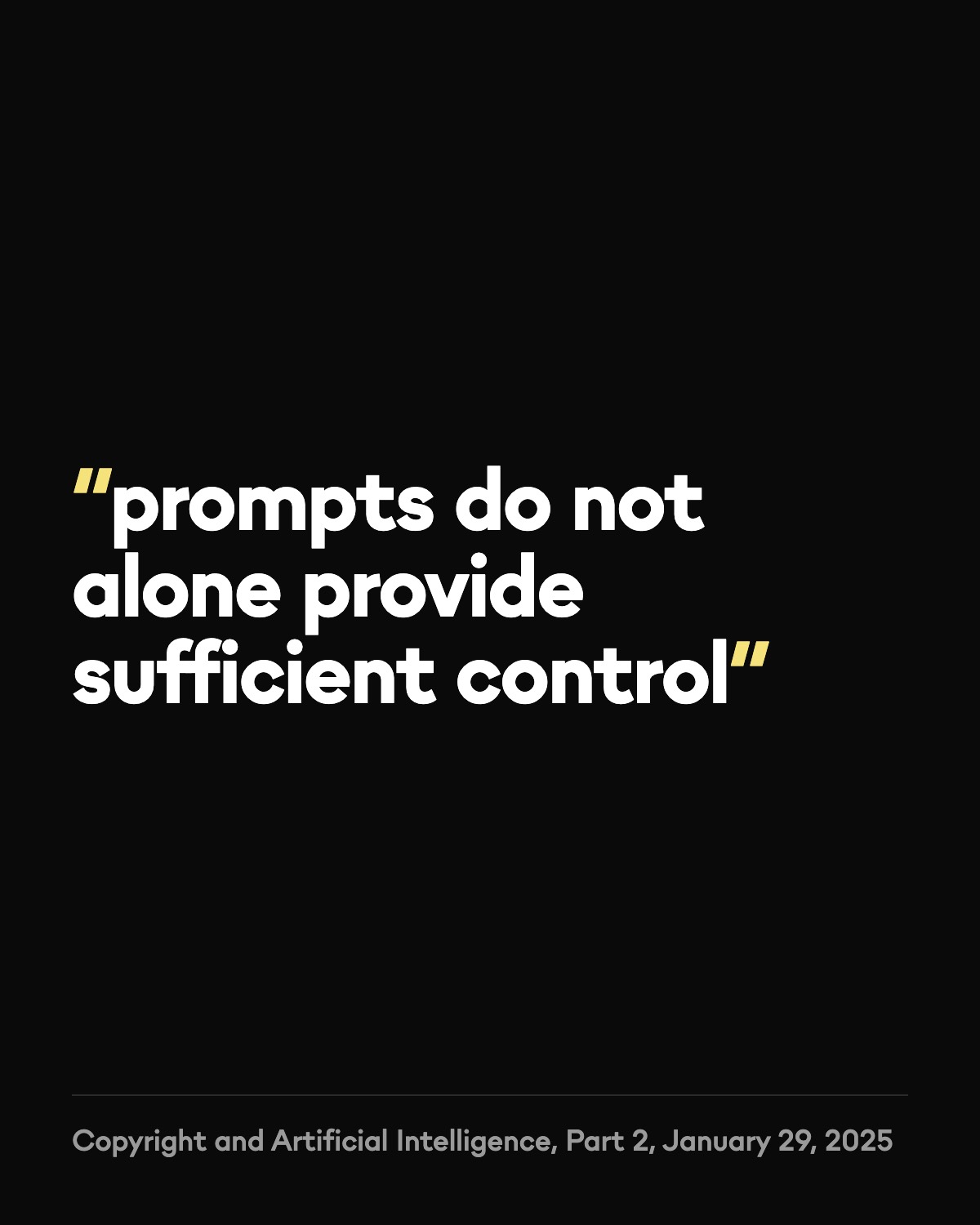
Part 2 of the Office's report (January 2025) gives prompts a full section. Its conclusion: "Based on the functioning of current generally available technology, prompts do not alone provide sufficient control."
What is protected is the human contribution: selection, arrangement, edits, when they involve enough creative choice.
In January 2025, the Office registered "A Single Piece of American Cheese". The application came from the company Invoke. The Office first refused it, and after the company sent a video of the work (about 35 edits to individual regions), it registered the selection, coordination, and arrangement of the AI-generated material.
When an application names the machine itself as the author, the Office refuses, and the courts have upheld that refusal. In Thaler v. Perlmutter, the U.S. Court of Appeals for the D.C. Circuit affirmed the refusal on March 18, 2025, and on March 2, 2026, the U.S. Supreme Court declined to hear the case. The case does not settle how much human contribution is enough: the application listed the machine as the author.
A registration application has to disclose AI-generated content that is more than de minimis. Under the 2023 guidance, applicants have "a duty to disclose the inclusion of AI-generated content in a work submitted for registration and to provide a brief explanation of the human author's contributions to the work." Under the same guidance, that content should be explicitly excluded from the application.
A studio that wants a registration describes in writing which parts a human conceived and executed.
The "there is no law yet" myth: infringement law applies, and the suits are already filed
Copyright infringement law already applies. There is no legal vacuum. Courts are working out how it applies to generative models right now, case by case.
On ownership, Part 2 of the Office's report (January 2025) reaches a similar conclusion: "Questions of copyrightability and AI can be resolved pursuant to existing law, without the need for legislative change."
Anthropic, the developer of the Claude models, will pay $1.5 billion under a settlement with book authors in Bartz v. Anthropic. The court granted final approval on July 20, 2026.
The settlement resolved claims over pirated copies of the books the model was trained on. It does not cover claims about what the model outputs. And output is what a studio ships.
Warner Bros. Entertainment, the Warner Bros. Discovery studio, filed its own suit against Midjourney on September 4, 2025. On November 4, 2025, the court consolidated it with the Disney and Universal case.
In their complaint, Disney and Universal seek up to $150,000 per infringed work. That is the statutory ceiling for willful infringement. A plaintiff can elect these statutory damages instead of actual damages and the defendant's profits.
The "the contract covers it" myth: indemnification decides who pays but does not find the problem
Indemnification is a contract clause under which one party covers the other's losses from third-party claims. It decides who pays. It detects nothing, and it does not show which asset is the problem.
There are two different cases.
In the first case, the model developer gives the indemnity, and it applies on the developer's terms. For example, Microsoft commits to defend Azure OpenAI customers against certain third-party intellectual property claims over model output. The condition: the customer has implemented the required mitigations in Microsoft's documentation, for example a system instruction telling the model not to infringe copyright, and testing for output of third-party content. Such an indemnity usually protects only the developer's own customer. A studio that received the material from an agency is usually not covered.
A claim can also be brought against whoever published the material. An indemnity cannot take back a spot that has already aired.
In the second case, the agency gives the client an indemnity. Then the agency takes on a risk that nobody checked before release. If a claim arrives, the agency can lose more than money: the material may have to be pulled and remade, and then the schedule slips.
The order that works is the boring one: check the output, record what was flagged, what was decided, and who decided it. Then let the contract allocate the remaining risk.
A record of a flagged AI asset works against the studio unless it explains the decision
A record that says "flagged, shipped anyway" with no explanation can be read in a dispute as evidence of willfulness. That is why the decision on a disputed asset is usually made by counsel, and its grounds are recorded along with the decision.
The question of fact: what is in the frame and what it resembles. The question of law: can it ship, does it need a license, is a registration worth filing, what goes in the disclosure, what to do when a claim arrives. A pre-release check answers the first. A lawyer answers the second.
Different kinds of resemblance raise different legal questions. A similar face is a right of publicity question, a similar logo is a trademark question. Style on its own is generally not protected by copyright.
Insurers already ask how a production checks AI-generated material
Front Row Insurance, a film and television insurance broker, wrote in July 2025 that a production will have to tell its insurer how it verifies that AI-generated material does not infringe third-party rights. According to the broker, a production may be unable to get errors and omissions (E&O) coverage, the policy that covers rights claims over the material, for that material. Studio counsel will be the one answering that question.
In January 2026, Insurance Services Office (ISO), which drafts standard policy forms for the U.S. insurance market, introduced a generative AI exclusion for commercial general liability policies. It is an endorsement: an insurer can add it to a policy, and then bodily injury, property damage, and personal and advertising injury arising out of generative AI fall outside coverage.
What studio counsel should write down before AI-generated material ships
The next step for studio counsel is two documents. Write down which parts of your AI-assisted work a human conceived and executed: a registration application will require it. Then write down where in your pipeline output gets checked before release, or, if you are an agency, before it reaches the client. If the answer is nowhere, that is a gap, and the contract will not close it.
Subscribe below to get one long-form article a week.
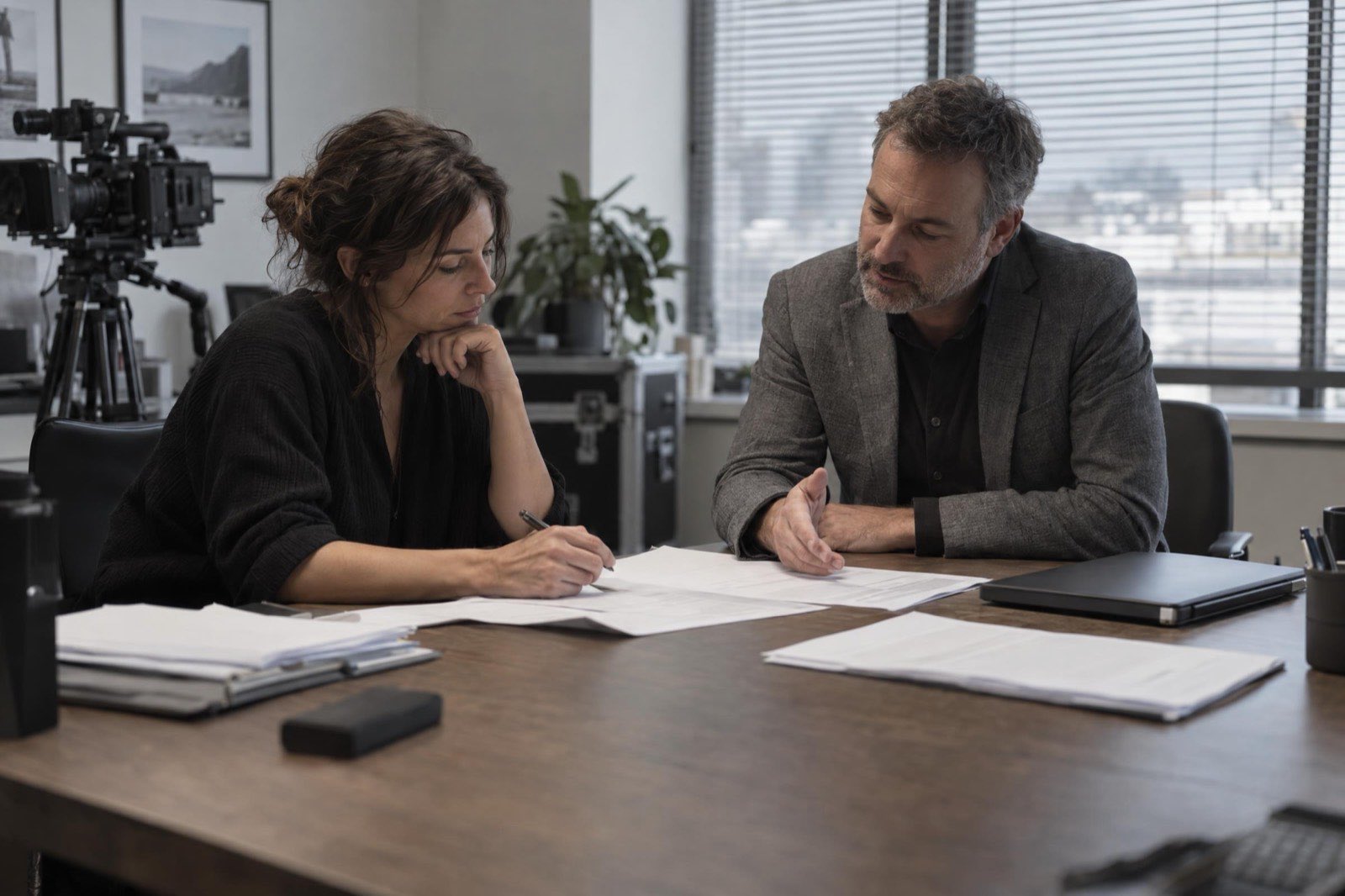
The photographs in this article are AI-generated. Each one was checked for matches against protected works before publishing, and two were regenerated after the check flagged a castle close to a protected design and recognizable branded hardware.
This is not legal advice.
Score a generation before it ships
CopySight checks an AI-generated image against known characters, faces and brands, and returns a similarity score with the matches behind it.
One long-form a week
We publish one article a week on how AI copyright risk actually works and what teams do about it. Leave an email and each one arrives the day it goes up.