Enterprise AI deals stall on one IP question
Deals that did not close: who on the buyer's side asks about third-party rights, why at the very end, and how to count the deals that stalled on it.
Enterprise deals at AI image and video platforms often stall at the very end. The buyer's lawyers and brand managers ask whether the outputs contain someone else's characters and logos (third-party intellectual property, or IP) or real people's faces, and who is liable for an image like that. A model refusal and an "AI-generated" label don't show what's in the image. The buyer expects the platform to tell a risky output from a clean one before it's published.
Where the deal goes quiet
Typically, an enterprise deal goes quiet at brand and legal approval on the buyer's side, after the product has already been chosen. Before that, the buyer's team compares models, tests your API and negotiates volume.
Then there's a pause in the thread. Someone who wasn't on the demo joins the next call, and the lawyers send a redline to the indemnification clause. After that, the buyer stops replying.
If the buyer does give a reason, it sounds like this: the brand team won't sign off on a service that might draw someone else's character. Legal wants to know who pays if an image like that ends up in an ad campaign.
At the start of a deal, the buyer asks about model quality, price and the API. At the end, they ask what will show up in the finished image or video, and who is liable for it.
Who asks about rights, and why at the end
Brand managers and lawyers on the buyer's side ask about third-party characters, logos and faces. They come in along with information security and procurement when the deal goes to approval, and they need an answer before signing. The person who tested the models is responsible for quality and speed. That's why the question usually doesn't come up in the demo, the trial or the technical evaluation.
The buyer isn't asking for a guarantee that a risky image will never be generated. No check can give that guarantee. How the platform and the buyer split the costs if an image does infringe someone's rights is a matter for the contract. What the buyer is asking is whether the platform can tell a risky image from a clean one before it's published.
Why model filters and "AI-generated" labels don't answer the buyer's lawyers
A model refusal, the model vendor's filter and an "AI-generated" label don't tell the buyer whether the finished output contains third-party characters, logos or faces. Each one answers its own, narrower question.
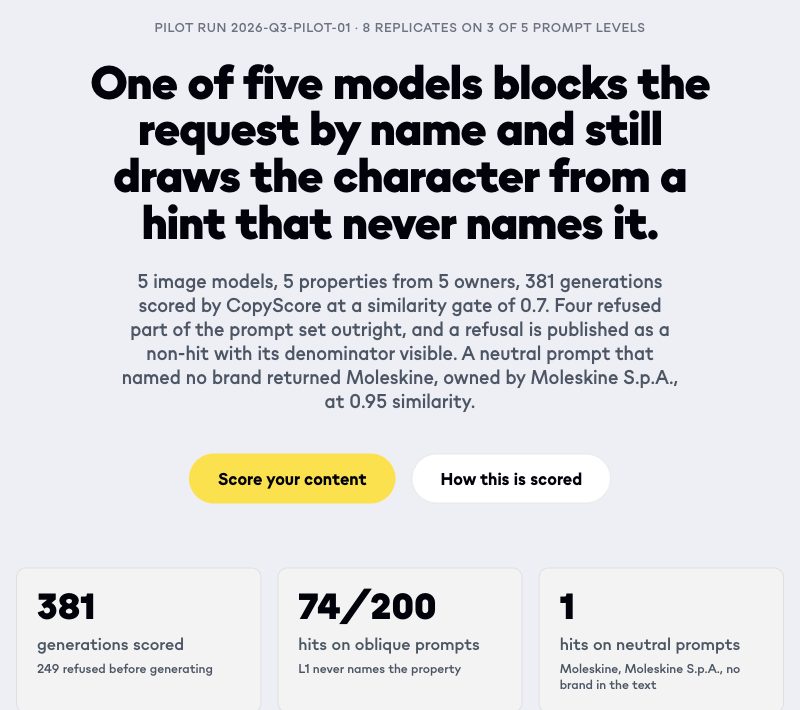
A model refuses based on the text of the prompt, for example when the prompt names a character. CopySight publishes the IP Risk Index, which compares what models draw when the prompt names a character with what they draw when it doesn't.
The IP Risk Index scored 381 generations across five image models. Separately, it logged 249 refusals: requests the models declined without drawing anything.
The index's headline finding: "One of five models blocks the request by name and still draws the character from a hint that never names it."
The run is preliminary, and the index page warns that it can't be used to rank the models yet. The details are in our breakdown of the index.
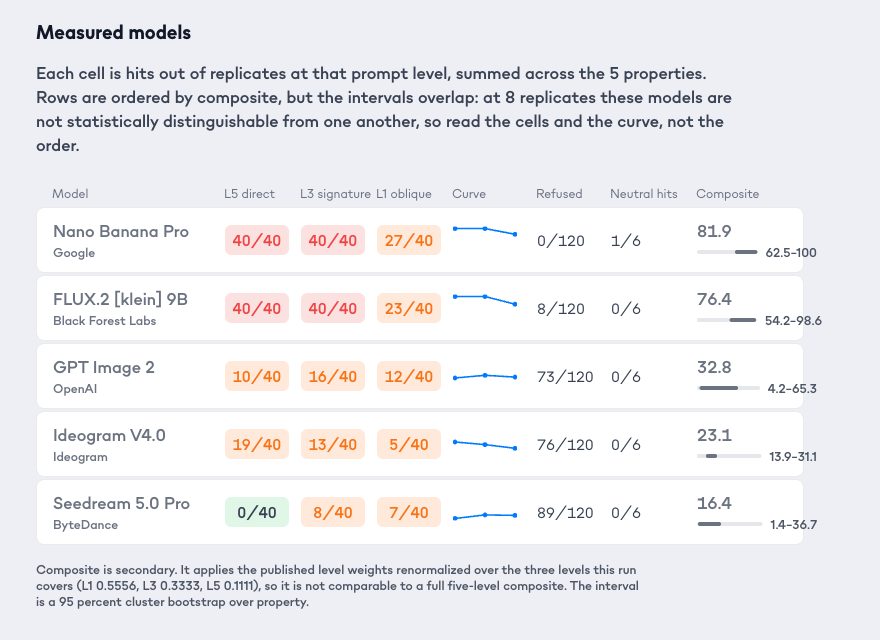
A vendor's filter covers only its own model and follows its own rules. If a platform offers models from several vendors, each has its own rules, and the buyer's lawyers need one answer for everything the platform puts out. No single vendor gives that answer. A vendor's promise to indemnify IP claims, where its terms include one, also covers only its own models.
An "AI-generated" label says that AI made the content. It doesn't show whose characters, logos or faces are in it. Since August 2, 2026, California's AI Transparency Act (SB 942) has required developers of large generative AI services to apply that kind of label. The label is embedded in the content itself so that a machine can read it. Article 50 of the EU AI Act has a similar marking requirement.
Why the answer is needed before the next approval
The buyer's lawyers already have two reasons to ask this question at the next approval. Studios have been suing the image generator Midjourney since 2025, and since January 2026 standard U.S. insurance policy forms have included a generative AI exclusion.
Disney and Universal sued Midjourney in June 2025 (Reuters). Warner Bros. filed a separate suit against Midjourney in September 2025 (Reuters).
Front Row Insurance, a film and TV insurance broker, asks productions how they verify that material made with AI doesn't infringe anyone's rights. According to the law firm Fenwick, in January 2026 the Insurance Services Office (ISO), which drafts standard U.S. insurance policy forms, added a generative AI exclusion to its commercial general liability forms. The exclusion applies to a policy only if the insurer adds it. When it does, the policy doesn't cover claims tied to generative AI, including advertising injury claims.
That's why, before signing, the enterprise buyer's lawyers ask the platform who is liable for an image that infringes someone's rights. For more on what insurers ask, see our notes from the panel on the future of Hollywood production.
Where a built-in rights check already exists
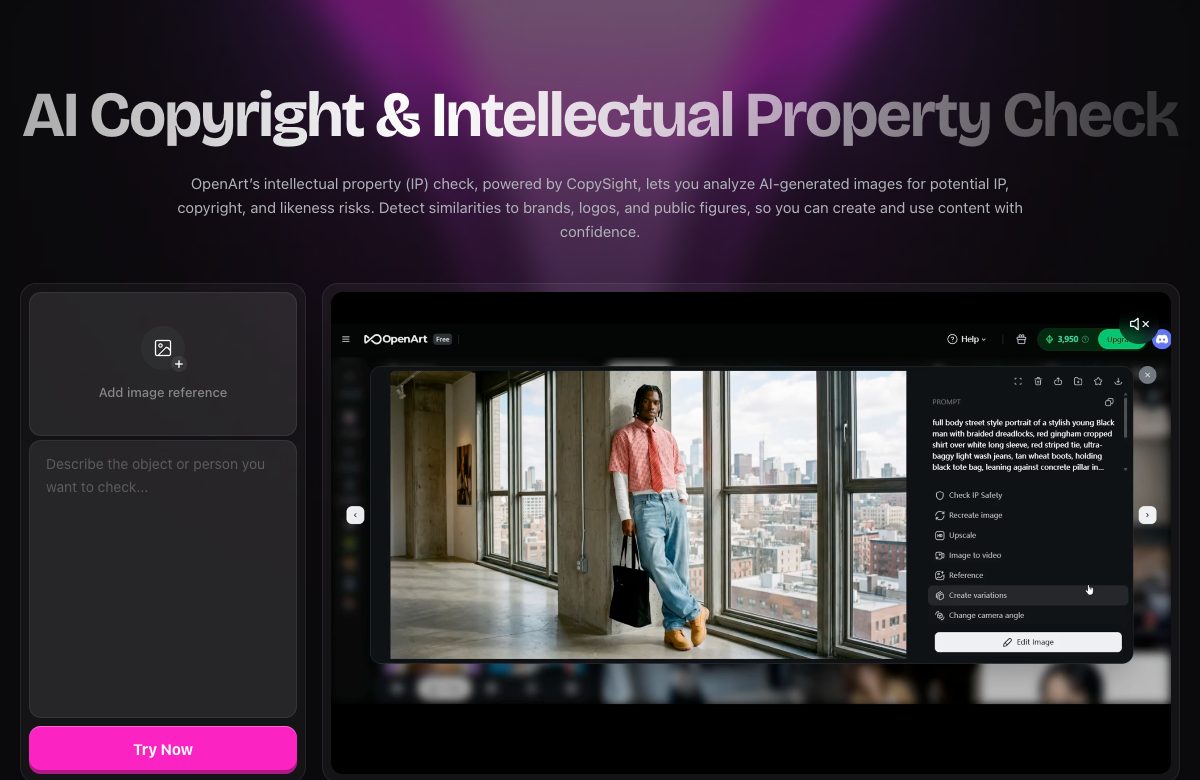
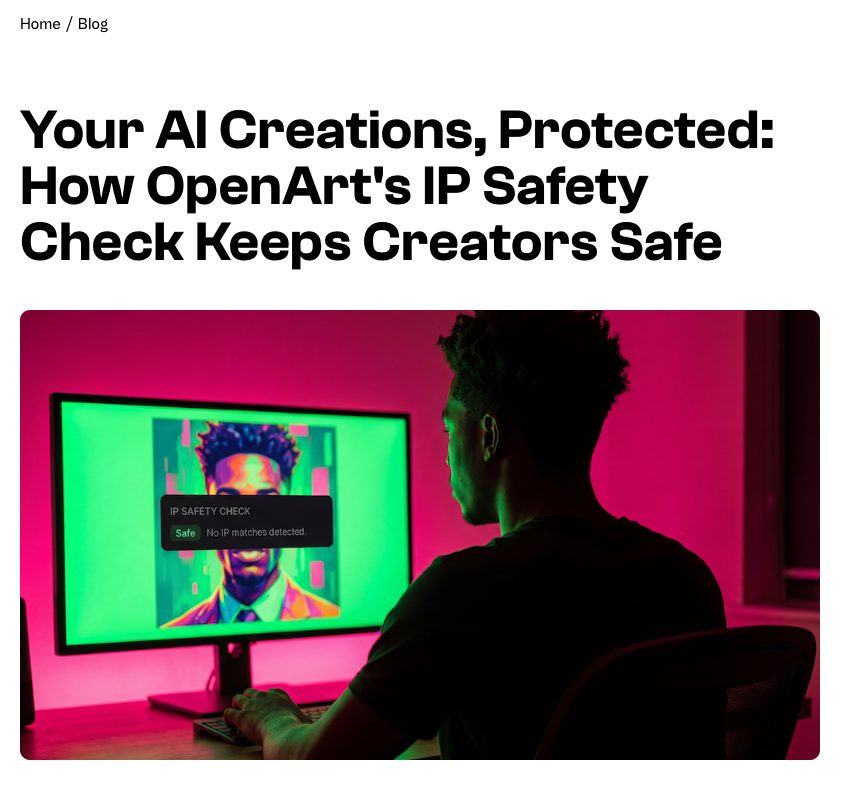
OpenArt, an AI image and video platform, already has a built-in check for third-party rights in images. On its feature page, OpenArt says the check is powered by CopySight, looks for similarities to brands, logos and public figures, and returns a Safe, Warning or Unsafe label. On the same page, OpenArt calls the result "a probability-based assessment, not a guarantee." In OpenArt's announcement, the feature is called IP Safety Check: the user runs the check manually, and on a Warning or Unsafe result sees what was flagged and why. The announcement adds that the check isn't meant to replace legal counsel.
How to count the deals lost to the rights question
You can count the lost deals in your CRM in about an hour. You'll need three lists of deals that were supposed to close this quarter.
- Deals where the buyer stopped replying once the deal went to brand, legal, information security or procurement for approval.
- Deals that stalled or fell through after the buyer sent back a redline to the indemnification clause.
- Pilots and trials that didn't turn into contracts.
For each deal on the three lists, reread the last email and the last contract redline, if there was one. Keep only the deals where the conversation was about third-party characters, logos, faces, or who pays if an image infringes.
Add up the value of the remaining deals, counting each deal once. That number exists only in your CRM.
Then flag the open enterprise deal that goes to that kind of approval next, and note the date. The total shows how much of this quarter's revenue is stuck where the buyer asked about third-party rights. The date shows when the question will come up again.
Deals that did not close is a CopySight blog series about what derails enterprise deals at AI image and video platforms. You can subscribe to the blog with the form below.
Score a generation before it ships
CopySight checks an AI-generated image against known characters, faces and brands, and returns a similarity score with the matches behind it.
One long-form a week
We publish one article a week on how AI copyright risk actually works and what teams do about it. Leave an email and each one arrives the day it goes up.